When we think of a tuning fork, we probably think of a small metal instrument used to tune musical instruments. But the tuning fork can also become a tool for exploring the relationship between sound, vibration, and our well-being.
Its ability to generate specific frequencies allows us to create sound experiences that are very different from those we usually find in music or other relaxation practices.
What are therapeutic tuning forks?
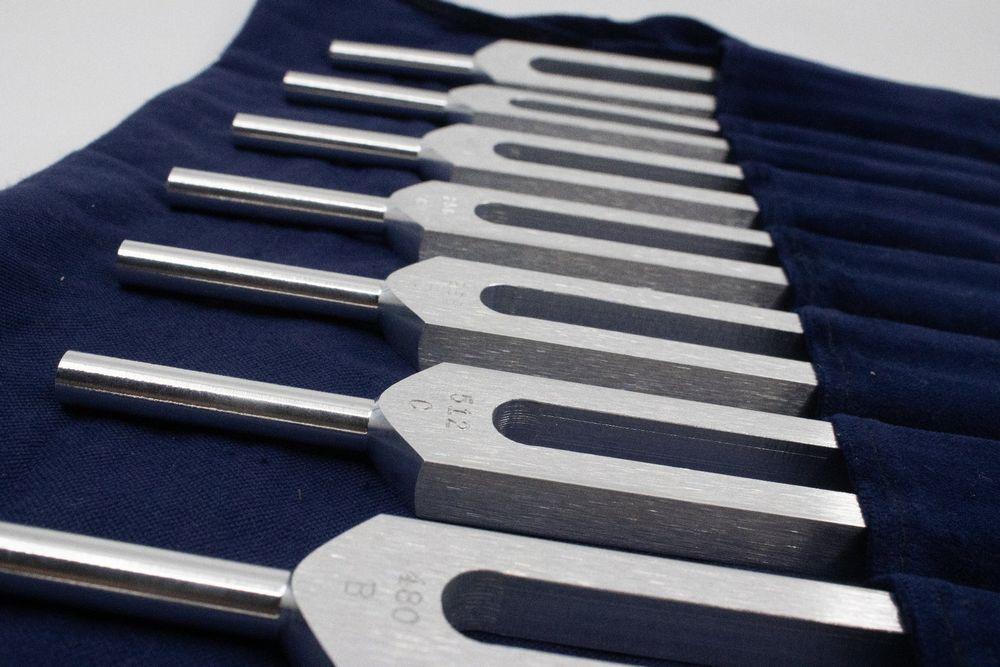
Tuning forks are instruments, generally metal, made up of two branches that, when activated, vibrate and generate a certain sound frequency.
In the field of sound therapy , tuning forks of different frequencies are used to create sound and vibrational stimuli that invite relaxation, body listening and connection with oneself.
Unlike other instruments, such as quartz bowls or gongs, tuning forks allow you to work with very specific fundamental frequencies and combine them intentionally.
How does a therapeutic tuning fork work?
When we activate a tuning fork, its branches begin to vibrate. This movement generates sound waves that propagate through the air and can be perceived by our auditory system.
The frequency of this vibration is measured in hertz (Hz). One hertz is equivalent to one oscillation per second.
For example, a 128 Hz tuning fork makes 128 oscillations per second, while a 528 Hz one makes 528.
Each frequency has particular acoustic characteristics. However, this does not mean that a specific frequency will necessarily produce the same effect on all people.
The way we perceive sound also depends on intensity, duration, context and our individual sensitivity.
Are all therapeutic tuning forks the same?
There are different types of tuning forks, with different characteristics and applications.
Mainly, we can distinguish between:
- Weightless tuning forks: they are commonly used to generate sound stimuli that are perceived through the ear.
- Tuning forks with weights: they allow a more perceptible mechanical vibration to be transmitted when applied to certain areas of the body.
There are also different work systems that use combinations of frequencies, musical intervals and sound sequences.
The choice of tuning forks depends on the methodology used and the characteristics of each session.
What happens when we hear two tuning forks at the same time?
One of the most interesting possibilities of tuning forks is the combination of two different frequencies.
When we hear two sounds simultaneously, we can perceive musical intervals, sensations of consonance or dissonance and, under certain conditions, acoustic phenomena such as heartbeats.
If a slightly different frequency is presented to each ear, the phenomenon known as binaural beats can also occur.
These experiences allow us to explore how our auditory system interprets and integrates sound stimuli.
It’s not just about listening to a sound, but also about observing what we experience while listening to it.
What benefits can therapeutic tuning forks provide?
Experience with tuning forks can provide a favorable space for:
- Physical and mental relaxation.
- The disconnection from everyday worries.
- Reducing the feeling of stress.
- Greater body awareness.
- The observation of one’s own emotions.
- Preparation for rest.
- The general feeling of calm and well-being.
Each person experiences this experience differently. Some perceive bodily sensations, others experience a deep sense of tranquility, and others simply enjoy a moment of rest.
Although there is research on the effects of sound and music on well-being, specific scientific evidence on therapeutic tuning forks is still limited.
For this reason, sound therapy should be understood as a complementary wellness practice and not as a substitute for medical or psychological treatments.
The Inner Sound method and therapeutic tuning forks
Inner Sound is a methodology for working with sound developed by Arden Wilken that incorporates different sound resources, including tuning forks and the voice.
At La Joieria, our way of working is based on this specialized training and a career of more than twenty years linked to sound.
The combination of frequencies, intervals and sound sequences allows the experience to be adapted to each person, respecting their rhythm and sensations.
It’s not about applying the same formula to everyone, but about offering a space for listening and personalized support.
What is a session with therapeutic tuning forks like?
The session begins with a conversation that allows us to find out how the person is and what they need at that moment.
Subsequently, the person remains comfortably lying down while receiving different sound stimuli in a quiet environment.
Depending on the session, the tuning forks can be placed near the ears or in other positions around the body, without the need for physical contact.
You don’t need to have musical knowledge, know how to meditate or make any effort.
If you have tinnitus, special hearing sensitivity or any medical condition that may be affected by sound stimuli, it is advisable to communicate this before starting.
Discover the therapeutic tuning forks in Cornellà de Llobregat, Barcelona
At La Joieria we offer individual sound therapy sessions in which tuning forks play a particularly relevant role.
We create a space where we can stop, listen and explore the relationship between sound, bodily sensations and our well-being.
We live surrounded by sounds, but we rarely give ourselves the opportunity to listen to them with full attention.
Maybe we don’t need to listen more, but rather learn to listen differently.
Would you like to personally experience the sound of therapeutic tuning forks? Discover our individual sessions and book your appointment at La Joieria.

Rubén Pérez Navarro, founder of La Joieria and specialist in sound therapy